
Consent doesn’t stop at birth.
Informed choice should cover every decision in maternity care. Including feeding your baby.
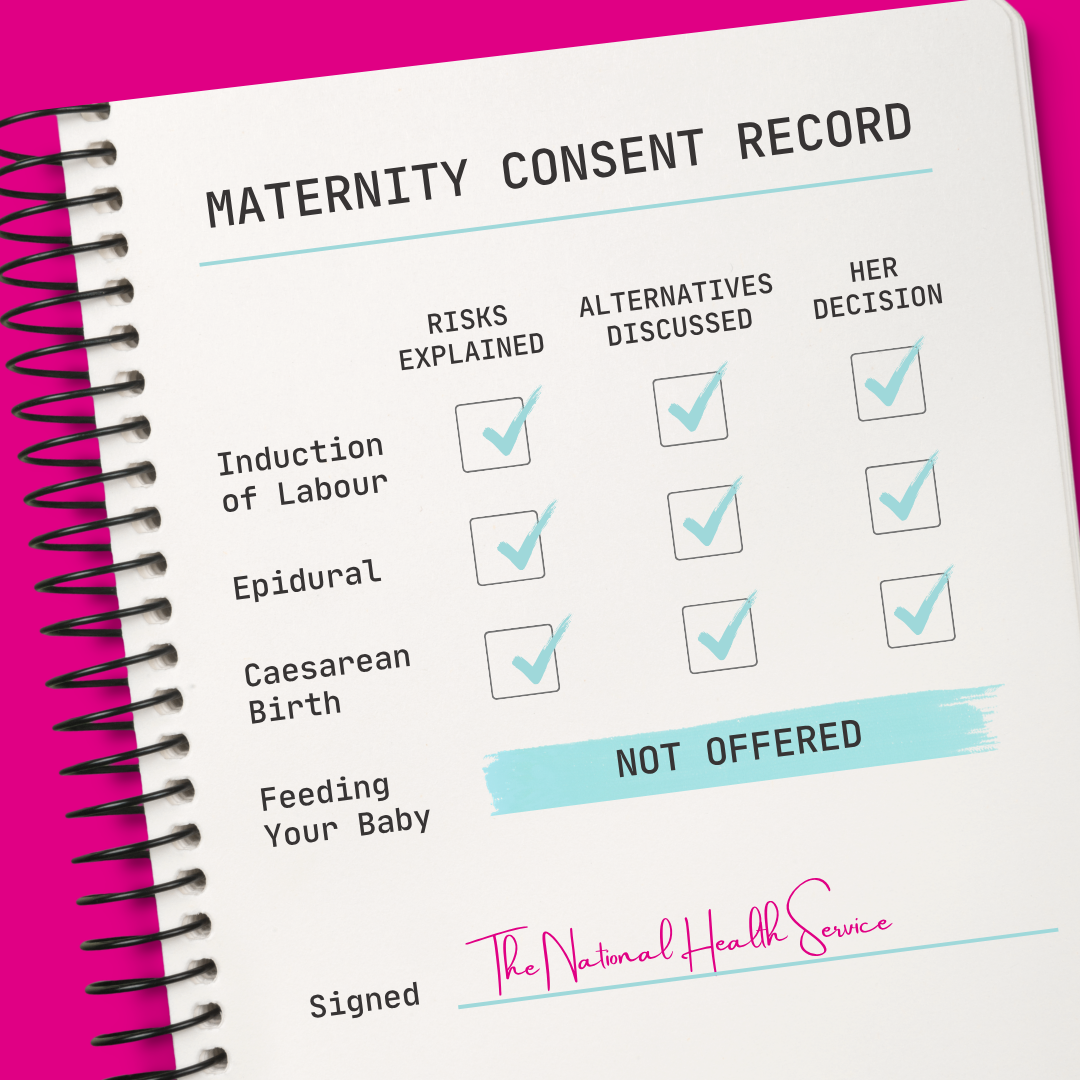
THE DOUBLE STANDARD
Safety. Evidence. Choice. Consent.
The NHS already promises women informed consent in maternity care. Infant feeding is the part where it doesn't deliver. Feeding happens in a woman's body, while she recovers from giving birth; she is a patient too, and so is her baby.
IN THEIR WORDS
Nobody told us.
“I was not told that insufficient breastfeeding causes jaundice and dehydration and could result in my baby being hospitalised... which is what happened.”
“We are absolutely not allowed in any circumstances to suggest formula. The Baby Friendly rules are so restrictive... it’s madness and we should be able to support mothers in all feeding options”
“They told us all about breastfeeding but when I asked about formula feeding and combi feeding I was told they weren’t allowed to tell us anything about it”
Care that trusts women.
WHAT GOOD LOOKS LIKE
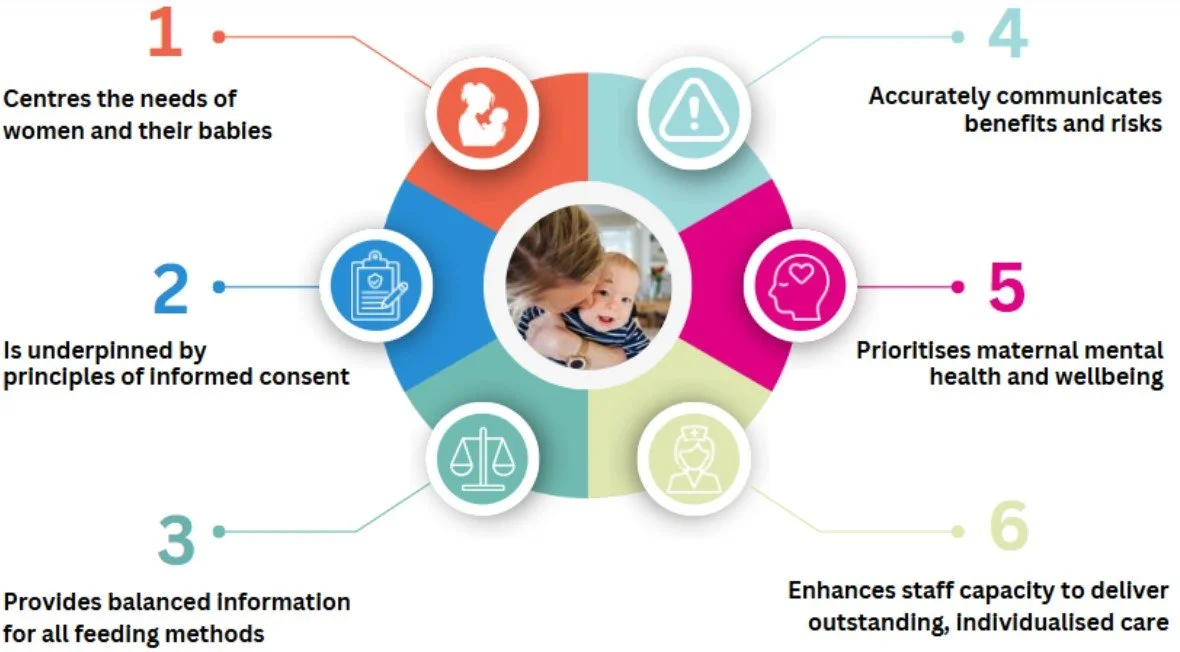
Tell her the risks
Milk can take time to come in. Some women are more likely to struggle, and there are clear signs a baby isn't getting enough. Every woman deserves to know before her baby arrives.
Tell her the alternatives
Bottles, boobs or tubes, or a bit of each. Breastfeeding, formula, mixed feeding and topping up for a few days are all safe, reasonable options, and she should hear about every one of them from the NHS rather than from an advert.
Respect her decision
It's her body, and she's a patient too. Once she knows, the choice is hers, with no judgement and no pressure. We put Mums before methods, and the NHS should too.
3 x
more newborns readmitted to hospital with jaundice than in 2008
The rate of babies readmitted with jaundice in their first two weeks has more than tripled since 2008. In 2024 there were over 26,000 of these admissions in England. The NHS doesn't record how these babies were fed, so it can't tell whether its own feeding policy is part of the problem.
Hospital Episode Statistics, England, babies aged 0 to 14 days, jaundice as primary diagnosis, per 1,000 live births. 2024 data provisional.

Give every woman her right to an informed choice
OUR ASKS
An informed consent standard
Infant feeding brought into line with the rest of maternity care, in NHS policy in England and Scotland.
Guidance rewritten around choice
NICE and SIGN guidance built on informed choice and the outcomes that matter for mothers and babies.
The full conversation, before birth
Every woman told about breastfeeding, formula and mixed feeding, what to expect and what to do if things don't go to plan.
Review, then rebuild
Baby Friendly accreditation paused while an independent review takes place, and a new NHS-owned standard built with women.
Every woman has a right to know.
TAKE ACTION
01. Sign the petition
Overhaul NHS infant feeding policy and end women's guilt and shame
We're asking the Health Secretary for an NHS infant feeding framework built on women's autonomy and choice: honest information about breastfeeding challenges, balanced advice on formula, combination feeding as a valid option, and women's mental and physical health taken into account.
750+
people have already signed. Help us reach 1,000.
02. Write to your representative
It takes two minutes. Health is run separately in each nation, so pick where you live, copy the letter and send it to your MP, MSP, Member of the Senedd or MLA.
-
Dear [MP's name],
I'm writing as your constituent to ask you to support every woman's right to an informed choice about feeding her baby.
Before an induction, an epidural or a caesarean, women are told the risks, the benefits and the alternatives. That is the standard the Supreme Court set in Montgomery v Lanarkshire, and it applies across the UK. Infant feeding is different. NHS England policy is built around UNICEF UK Baby Friendly accreditation, which focuses antenatal conversations on breastfeeding. Information about formula and mixed feeding is typically only given once a woman asks or has already decided, and women are rarely told beforehand why breastfeeding can be difficult, who is more likely to struggle, or the signs that a baby isn't getting enough milk. Informed consent means material risks and reasonable alternatives are discussed with every woman, not only those who know to ask.
Infant feeding happens in a woman's body. She is a patient in her own right, and her health matters alongside her baby's.
Baroness Amos's national maternity investigation has called for listening to women to be treated as a critical safety issue. Infant feeding should be no exception.
Feed, an independent charity with no conflict of interest, is campaigning for this change and has set out how it could work in practice at www.feeduk.org.
I’m asking you to:
ask the Health Secretary to include infant feeding, built on informed consent, in the new Modern Service Framework for maternity care;
support an independent review of NHS infant feeding policy, including its effect on the health of mothers and babies; and
back Feed’s call for every woman to get full, balanced information about all feeding options before her baby arrives.
Consent doesn't stop at birth.
Yours sincerely,
[Your name]
[Your address and postcode]
-
Dear [MSP's name],
I'm writing as your constituent to ask you to support every woman's right to an informed choice about feeding her baby.
Before an induction, an epidural or a caesarean, women are told the risks, the benefits and the alternatives. That is the standard the Supreme Court set in Montgomery v Lanarkshire, and it applies across the UK. Infant feeding is different. NHS Scotland policy is built around UNICEF UK Baby Friendly accreditation, which focuses antenatal conversations on breastfeeding. Information about formula and mixed feeding is typically only given once a woman asks or has already decided, and women are rarely told beforehand why breastfeeding can be difficult, who is more likely to struggle, or the signs that a baby isn't getting enough milk. Informed consent means material risks and reasonable alternatives are discussed with every woman, not only those who know to ask.
Infant feeding happens in a woman's body. She is a patient in her own right, and her health matters alongside her baby's.
Baroness Amos's national maternity investigation has called for listening to women to be treated as a critical safety issue. Infant feeding should be no exception.
Feed, an independent charity with no conflict of interest, is campaigning for this change and has set out how it could work in practice at www.feeduk.org.
I’m asking you to:
ask the Scottish Government's health secretary to commission an independent review of infant feeding policy in Scotland, including its effect on the health of mothers and babies;
support an informed consent standard for infant feeding across NHS Scotland; and
back Feed’s call for every woman to get full, balanced information about all feeding options before her baby arrives.
Consent doesn't stop at birth.
Yours sincerely,
[Your name]
[Your address and postcode]
-
Dear [MLA's name],
I'm writing as your constituent to ask you to support every woman's right to an informed choice about feeding her baby.
Before an induction, an epidural or a caesarean, women are told the risks, the benefits and the alternatives. That is the standard the Supreme Court set in Montgomery v Lanarkshire, and it applies across the UK. Infant feeding is different. Health and Social Care policy is built around UNICEF UK Baby Friendly accreditation, which focuses antenatal conversations on breastfeeding. Information about formula and mixed feeding is typically only given once a woman asks or has already decided, and women are rarely told beforehand why breastfeeding can be difficult, who is more likely to struggle, or the signs that a baby isn't getting enough milk. Informed consent means material risks and reasonable alternatives are discussed with every woman, not only those who know to ask.
Infant feeding happens in a woman's body. She is a patient in her own right, and her health matters alongside her baby's.
Feed, an independent charity with no conflict of interest, is campaigning for this change and has set out how it could work in practice. You can find out more at feeduk.org.
I’m asking you to:
ask the Minister of Health to commission an independent review of infant feeding policy in Northern Ireland, including its effect on the health of mothers and babies;
support an informed consent standard for infant feeding across Health and Social Care; and
back Feed's call for every woman to get full, balanced information about all feeding options before her baby arrives.
Consent doesn't stop at birth.
Yours sincerely,
[Your name]
[Your address and postcode]
-
Dear [MS's name],
I'm writing as your constituent to ask you to support every woman's right to an informed choice about feeding her baby.
Before an induction, an epidural or a caesarean, women are told the risks, the benefits and the alternatives. That is the standard the Supreme Court set in Montgomery v Lanarkshire, and it applies across the UK. Infant feeding is different. NHS Wales policy is built around UNICEF UK Baby Friendly accreditation, which focuses antenatal conversations on breastfeeding. Information about formula and mixed feeding is typically only given once a woman asks or has already decided, and women are rarely told beforehand why breastfeeding can be difficult, who is more likely to struggle, or the signs that a baby isn't getting enough milk. Informed consent means material risks and reasonable alternatives are discussed with every woman, not only those who know to ask.
Infant feeding happens in a woman's body. She is a patient in her own right, and her health matters alongside her baby's.
Feed, an independent charity with no conflict of interest, is campaigning for this change and has set out how it could work in practice. You can find out more at feeduk.org.
I’m asking you to:
ask the Welsh Government's health secretary to commission an independent review of infant feeding policy in Wales, including its effect on the health of mothers and babies;
support an informed consent standard for infant feeding across NHS Wales; and
back Feed's call for every woman to get full, balanced information about all feeding options before her baby arrives.
Consent doesn't stop at birth.
Yours sincerely,
[Your name]
[Your address and postcode]
Your experience is evidence. We'll use Mums' stories, with permission, to show government what needs to change. You choose whether you're named, and there's no judgement here, however you fed your baby.
Share the campaign: #ConsentIsCare #BottlesBoobsOrTubes
03. Share Your Story